





THE ROLE OF HETEROGENEITY IN GROUNDWATER CHEMISTRY AND MIXING WITHIN THE CRITICAL ZONE OF A VOLCANIC ROCK HILLSLOPE
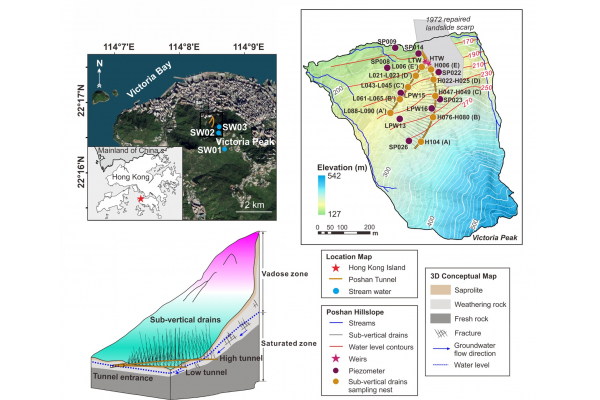
Limited high-resolution geochemical observations in heterogeneous critical zones (CZ) hinder understanding of hydrological connectivity and hydrochemical evolution, particularly in urbanizing mountainous regions. The Poshan drainage tunnel system in Hong Kong, where two sub-tunnels intersect dense sub-vertical drains, provides a groundwater observation platform to evaluate how CZ heterogeneity controls solute behavior. Groundwater chemistry was analyzed using diagnostic tools of mixing models (DTMM), end member mixing analysis (EMMA) and hydrochemical indicators, identifying two primary controls: physical mixing among chemically distinct waters and biogeochemical reactions. Two representative solutes showed contrasting mechanisms: NO₃⁻ was from soil leaching and controlled by heterogeneity-driven mixing, whereas Si was controlled by silicate weathering under kinetic and thermodynamic constraints.
For additional information, please contact Miss Tao Yang, taoy@connect.hku.hk.