





INVESTIGATING WOLF-RAYET CENTRAL STARS OF PLANETARY NEBULAE
Seminars
Semester 2
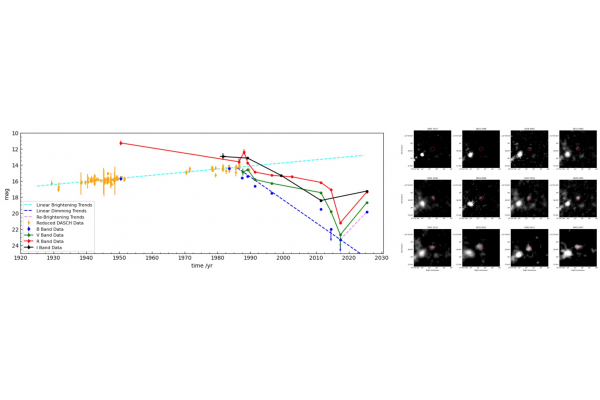
Planetary nebulae (PNe) are the ejected glowing envelopes of low- to intermediate-mass stars whose central remnant cores (CSPNe) are hot and evolving towards white dwarfs. A subset of CSPNe are hydrogen-deficient with very fast winds that exhibit so-called Wolf-Rayet-like spectra designated as [WR] to distinguish them from their high mass, short-lived counterpart WR stars. Studying these [WR] CSPNe, the objective of my project, provides special insights into late-stage stellar evolution, nucleosynthesis process, binarity, and the chemical enrichment of the interstellar medium. In this study, we investigated the photometric variability of [WR] CSPNe using unique, century-long photographic plate data from the Digital Access to a Sky Century @ Harvard (DASCH) database. Through DASCH data calibration and exploration of other photometric and spectroscopic data, our preliminary results indicate that many [WR] CSPNe exhibit significant photometric variability on timescales ranging from several years to more than half a century. This long-term variability offers insights into potential binary companions and unique, relatively short-time dependencies in the evolutionary processes, such as a very late thermal pulse. Key discoveries will be discussed in this presentation.
For additional information, please contact Mr. Zhengjie Tian, zhengjie@connect.hku.hk