





DYNAMICAL ANALYSIS OF THE 5:1 MEAN-MOTION RESONANCE OF THE HD 202206 SYSTEM
Seminars
Semester 2
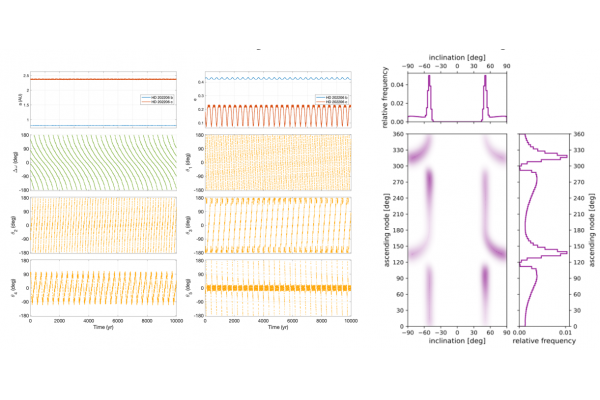
The HD 202206 system, featuring two substellar companions in a 5:1 period ratio around a solar-type star, offers a rare opportunity to study high-order mean-motion resonance (MMR) and provides new insights into the dynamical evolution of substellar companions in extrasolar planetary systems. Previous studies established the dynamical structure around the 5:1 commensurability (Correia et al. 2005). More recently, Benedict & Harrison (2017) claimed that this system is nearly face-on, with an inclination of approximately 10°, which implies large masses for the companions, with the inner companion being a low-mass M dwarf. However, this assertation remains controversial. We have performed a new dynamical fit to all available radial velocity data from the CORALIE and HARPS spectrographs. The EXO-STRIKER toolkit was employed for the fitting process (Trifonov 2019). We assessed the long-term stability of the system using a Nested Sampling algorithm. An analysis of the astrometric jitter around the best fit in the Gaia DR3 catalog and the proper motion anomalies between Hipparcos and Gaia showed that the orbital inclinations are strongly constrained to about 51°. Our best-fit dynamical solution, assuming a coplanar and inclined (i = 51°) configuration, yields actual mass of 21.22 MJ and 3.08 MJ for the inner and outer companions, respectively. The corresponding orbital periods are 256.26 days and 1298.69 days, with eccentricities of 0.43 and 0.18. The evolution of the five resonant angles shows that only one of the angles is librating, indicating weak but persistent resonant behavior. Our stability analysis confirms that the system is dynamically stable. HD 202206 c is a giant planet while HD 202206 b is firmly in the brown dwarf regime. Identifying a resonant system that contains both a brown dwarf and a giant planet therefore provides valuable insight into the formation of planets and brown dwarfs, and into the possibility of a continuous transition between the two populations.
For additional information, please contact Miss Yingyi CAO, astrocyy@connect.hku.hk.