





DEGLACIAL SEA-LEVEL HISTORY OF THE EAST CHINA SEA COAST: EVIDENCE FOR TWO MELTWATER-DRIVEN ACCELERATION EPISODES
Seminars
Semester 2
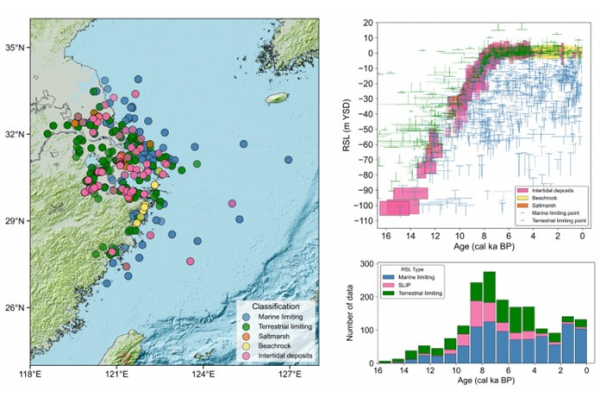
The timing and magnitude of deglacial sea-level rise along the East China Sea coast remain poorly constrained due to inconsistent data standardization. Here we compile a comprehensive relative sea-level (RSL) database for the East China Sea coast spanning the last 16 kyr, following the international standard protocol and assigning a quality-scoring scheme for all sea-level indicators. After rigorous screening of 2,249 geological records, we retain a quality-controlled dataset of 296 sea-level index points and 1,573 limiting points. Using a spatio-temporal empirical hierarchical model incorporating glacial isostatic adjustment (GIA) model priors, we reconstruct RSL and its rates of change across seven sub-regions and identify two prominent acceleration episodes at 11–11.7 ka and 9–9.5 ka, with median rates reaching 12–15 mm/yr. RSL budget decomposition suggests that the global meltwater signal is the primary driver. Furthermore, by testing various ice-history delay scenarios, we find that a 1.5 kyr delay best reproduces our geological observations. We tentatively attribute these episodes to Meltwater Pulse 1B and the final phase of Northern Hemisphere deglaciation, respectively, offering far-field constraints on the timing of post-glacial ice-sheet collapse.
For additional information, please contact Mr. GAO Chengcheng, chengao@connect.hku.hk.