





MICROSTRUCTURES AND ELEMENTAL PARTITIONING WITHIN BALLISTICALLY DISPERSED MELT PARTICLES FROM METEOR CRATER, ARIZONA

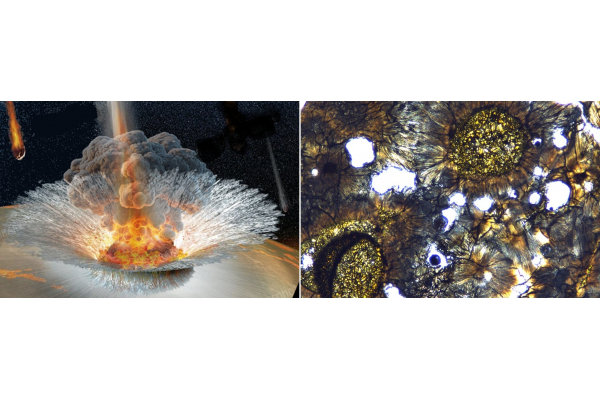
Meteor Crater in Arizona, a 1.2-km-diameter structure formed by the impact of a ∼40-m iron meteorite, serves as a natural laboratory for investigating hypervelocity impact processes. Melt particles were ballistically dispersed at supersonic velocities during the impact, producing hypocrystalline melt beads composed of pristine and banded glass, hopper olivine, and polycrystalline pyroxene spherules, along with aggregates of detrital quartz, dolomite, and lithic fragments. Integrated optical microscopy, SEM-BSE imaging, EDS, EBSD, and synchrotron Laue microdiffraction reveal predominantly polycrystalline clinopyroxene spherules with hopper olivine in a glassy groundmass, and minor barite and carbonate as secondary precipitates. Dispersed Fe-Ni metal grains composed of taenite and micron-scale Ni-rich inclusions preserve a record of the vaporized impactor. Elemental mapping shows rapid partitioning associated with the formation of the clinopyroxene spherules. Hopper olivine and dendritic pyroxene textures indicate supersaturated, high-cooling-rate conditions. The microstructural and chemical variations record melt production, vapor condensation, and early post-impact alteration. These data provide constraints on melt-zone volume, cooling rates, and impact P-T conditions, and quantify impactor–target mixing in rapidly quenched ejecta at Meteor Crater.
For additional information, please contact Prof. LS Chan, chanls@hku.hk.