





SEQUENTIAL LANDFALL TROPICAL CYCLONES IN CHINA AND THE US
Seminars
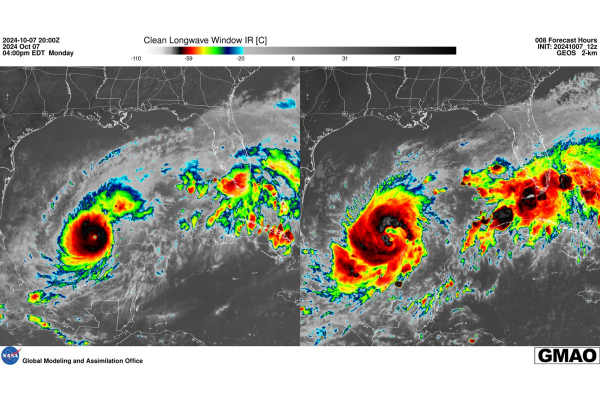
On 16 and 19 September 2024, two tropical cyclones (TCs), Bebinca and Pulasan, made successive landfalls in Shanghai, China. This kind of “back-to-back” strike was mirrored across the Pacific by the successive landfalls of Hurricanes Helene and Milton in the United States just weeks later. Unlike isolated landfall events, such sequential landfall TCs (SLTCs) represent a form of compound hazard, in which the shortened “recovery window” between landfalls can lead to disproportionate socio-economic damage.
Although multiple tropical cyclone events (MTCEs) over the open ocean have attracted growing attention in recent years, SLTCs remain much less discussed. Previous studies have mainly focused on synthetic storm simulations for the US East and Gulf coasts, leaving the climatological characteristics and physical mechanisms of SLTCs across different high-risk basins insufficiently understood. This study aims to understand why some coastal regions experience repeated tropical cyclone landfalls within unusually short time intervals, and whether such events share common climatological and dynamical characteristics across China and the United States.
For additional information, please contact Mr. Qian XIANG, qianxiang@connect.hku.hk.