





HIGH-QUALITY SPECTRAL ANALYSIS OF MINERALOGY IN MARTIAN PALEOLAKES
Seminars
Summer Semester
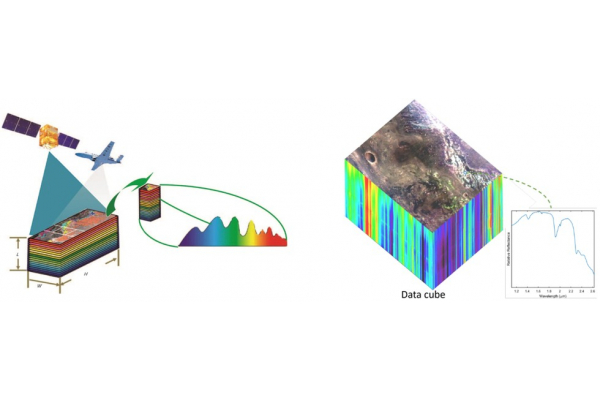
Hyperspectral imaging, the simultaneous acquisition of spatial and spectral information, plays a crucial role in the fine recognition and extraction of materials. However, image resolution and noise significantly impact the accuracy of these identifications. In this study, we address these challenges by investigating image quality enhancement and fusion methods. We then apply these advanced techniques to conduct a detailed mineralogical analysis of two ancient lake regions on Mars, aiming to shed light on the regional geological history and climate change. First, we address the problem of complex noise in hyperspectral imaging. For mixed Gaussian and stripe noise, we propose the EGD-Net. This method utilizes a subspace representation to reduce computational complexity and designs a general guided diffusion model, allowing the network to effectively handle non-Gaussian noise. For Martian hyperspectral data, we introduce E2E-CRISM, an efficient self-supervised denoiser. By projecting images onto a subspace and using an eigenimage-guided neighborhood sampler, E2E-CRISM generates its own training data and accurately retrieves mineral information from noisy spectra without over-smoothing critical absorption features. Furthermore, to address limitations in spatial resolution, we propose a hyperspectral and multispectral image fusion framework, termed E2E-fusion. This method integrates a self-supervised deep learning prior, E2E, into a Plug-and-Play alternating direction method of multipliers framework. By exploiting the spectral low-rank structure of hyperspectral images, our method iteratively optimizes the fusion process to generate high-resolution results. The effectiveness of the proposed denoising and fusion approaches is demonstrated through comprehensive experiments on both simulated and real-world datasets, consistently outperforming state-of-the-art methods. Finally, leveraging these advanced image processing techniques, we conduct a detailed mineralogical investigation of two Martian paleolakes: McLaughlin crater and the Eridania basin. This high-quality spectral analysis provides new insights into their formation and implications for the geological and climatic history of Mars.
For additional information, please contact Mr. Zhicheng WANG, wangzc22@connect.hku.hk.