





DEFORMATION SURVEY OF REMOTE AND POORLY MONITORED VOLCANOES WITH OPERATIONAL SATELLITE RADAR INTERFEROMETRY MISSIONS
Seminars
Summer Semester
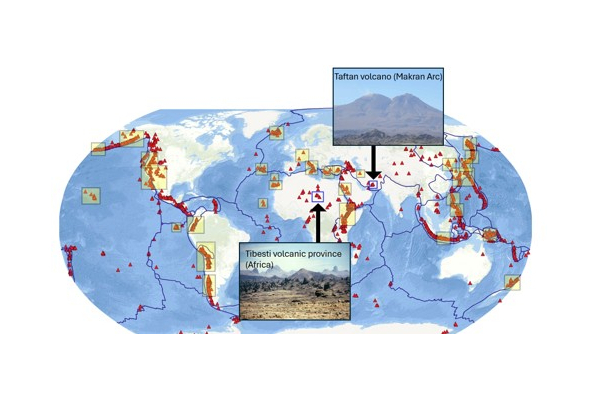
To address persistent global monitoring gaps and advance our understanding of volcanic eruption cycles, this study exploits a decade of Sentinel-1 InSAR data across remote and understudied volcanic regions, while introducing improved processing strategies. In the Makran subduction zone, we present the first geodetic evidence of unrest at Taftan volcano, identifying a 10-month period of summit uplift (~11 cm/yr) likely driven by deep magmatic intrusion or hydrothermal pressurization. In contrast, analysis of the intraplate Tibesti Volcanic Province (Chad) reveals localized subsidence (−2.2 to −8.5 mm/yr), interpreted as long-term cooling and contraction of Holocene magma bodies rather than active unrest, while also disentangling phase-related InSAR artifacts. Methodologically, we develop a novel Common Mode Filter (CMF) to effectively reduce atmospheric noise in steep volcanic terrains, and compare a high-resolution, burst-level COMPASS–Dolphin time-series workflow with conventional InSAR pipelines. This approach minimizes storage demands and overcomes limitations of cloud-based platforms. Together, these contributions provide a scalable and computationally efficient framework for improving global volcano deformation monitoring.
For additional information, please contact Mr. Mohammadhossein MOHAMMADNIA, mhmnia@connect.hku.hk.