





PERIGLACIAL LANDSCAPES OF NORTHERN HEMISPHERE OF MARS: DETECTION, DISTRIBUTION, AND THEIR IMPLICATIONS FOR PALEOCLIMATE
Seminars
Semester 1
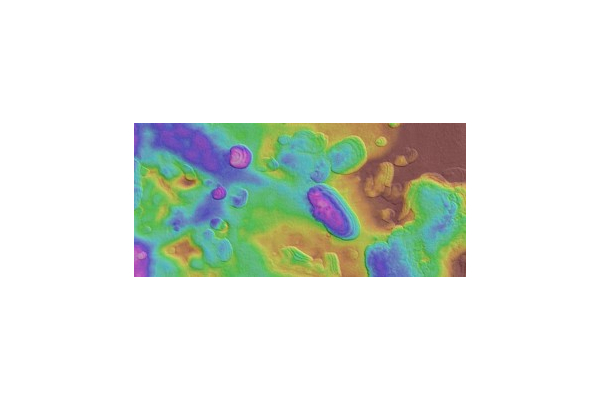
This research explores the abundance and importance of small thermokarst-like and scalloped depression features in Utopia Planitia, Mars, through a deep-learning approach using Context Camera (CTX) mosaic images. This research was prompted by the possibility that earlier studies greatly underestimated the number of
these features, especially on small scales, because they are small, subtle, and can be confused with other shallow depressions. To overcome this potential bias, we used a Mask R-CNN model in ArcGIS Pro to identify candidate features across the region of interest. The new data set reveals that the population of small basins is much larger than we previously thought, and many more examples may still be found in the northern hemisphere of Mars. These findings also provide valuable clues to the history of climate change on Mars and its relationship with varying obliquity that became the reason for formation of these types of features. Therefore, the identified landforms not only constitute a geomorphic catalog, but also a record of climate-sensitive processes in the Amazonian period.
The approach used in this study does not eliminate the need for manual geomorphic interpretation and verification; the study is consistent that detection can help streamline the process of inventory construction at the regional scale. In this light, the thesis not only provides a new geomorphic data set, but also a new approach to surface analysis that can be applied elsewhere.
For additional information, please contact Mr. Syed Hassan Iqbal Ahmad SHAH, hassan12@connect.hku.hk.