





SEDIMENTARY LANDFORMS ON EARLY MARS AND IN THE QAIDAM BASIN, TIBETAN PLATEAU: AN ANALOG STUDY
Seminars
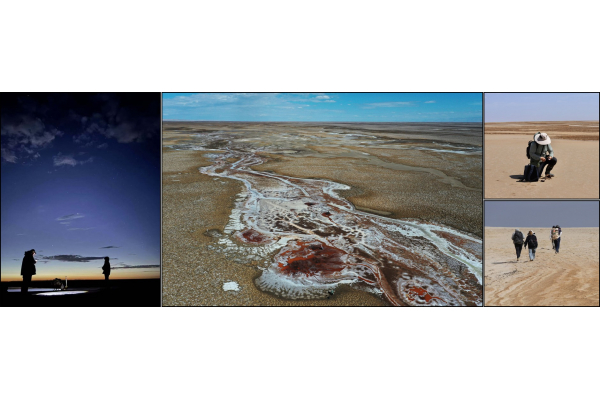
The dramatic evolution of Mars from warm-and-wet to cold-and-dry remains a mystery. Although early Mars hosted extensive valley networks and lakes, subsequent atmospheric thinning and climate cooling led to planetary-scale desiccation. Surface water was lost to space or sequestered underground, leaving behind a complex sedimentary record that captures the terminal stages of Martian hydrology. In this study, I integrate remote sensing, drone photogrammetry, sedimentological profiling, field sampling, and mineralogical spectroscopy examining terrestrial sedimentary analogs to investigate the depositional processes underlying this environmental shift and evaluate the potential for biosignature preservation. My main findings are: (1) Gypsum ridges in the Qaidam Basin formed through an outsalting brine-mixing mechanism, providing a formation model for Martian irregular polygonal ridges as potential deep-biosphere habitats. (2) The stratigraphic evolution of scarp-fronted and alluvial fans indicates that late-stage Martian fluvial activity may have been driven by episodic glacial thaws in a cold climate rather than by continuous precipitation. (3) Observations of freezing dynamics within unvegetated, hypersaline fluvial channels reveal that subsurface clays offer crucial shielding against UV radiation and oxidation, highlighting late-stage Martian chloride deposits as vital refuges and optimal targets for preserving astrobiological biosignatures. By hosting these diverse features, the Qaidam Basin serves as an ideal natural laboratory for Mars analog studies, helping decode this climatic transition and the progressive loss of fluid environments.
For additional information, please contact Mr. Zikang LI, zikang94@connect.hku.hk.